“Turn and face the strange” – David Bowie, Changes
There is a predictable pattern that has recurred throughout time across otherwise unrelated industries – value chains fracture, and the process of capital allocation becomes more specialised. At the risk of generalising, this tends to be led by the company, or companies, that hold the strongest position in the industry, whereby they jettison, or actively encourage competition in, the less value-creative parts of their business models. This pattern happens so often that it is worth thinking about in relation to recent developments in AI and among the hyperscalers.
As representative champions of America’s and China’s technology sector, respectively, Alphabet (1.6% of the portfolio, held since 2013) and Tencent (0.3%, held since 2018) have spent two decades occupying cosy, near-insurmountable positions in the old technology value chain. Both held the keys to the internet’s front door in their respective home markets – via Search, YouTube, Gmail and Android in Alphabet’s case; Weixin and its 1.44bn monthly users in Tencent’s.
Over the last decade the US tech giants have delivered materially better share price returns than their Chinese counterparts, as the US players each largely stuck to their own niche offerings, carving out monopolistic market share within their own channels – i.e., Alphabet in search, Meta in social media, Microsoft in enterprise software, Apple in consumer hardware and Amazon in e-commerce. Meanwhile the major Chinese players – Tencent, Alibaba, Baidu, JD.com, Meituan – battled across each channel, ultimately competing away returns. As the AI value chain continues to evolve dramatically, this dynamic appears to be reversing. The US technology giants are increasingly encroaching on one another’s domains, while the Chinese businesses appear to be showing increased pricing discipline.
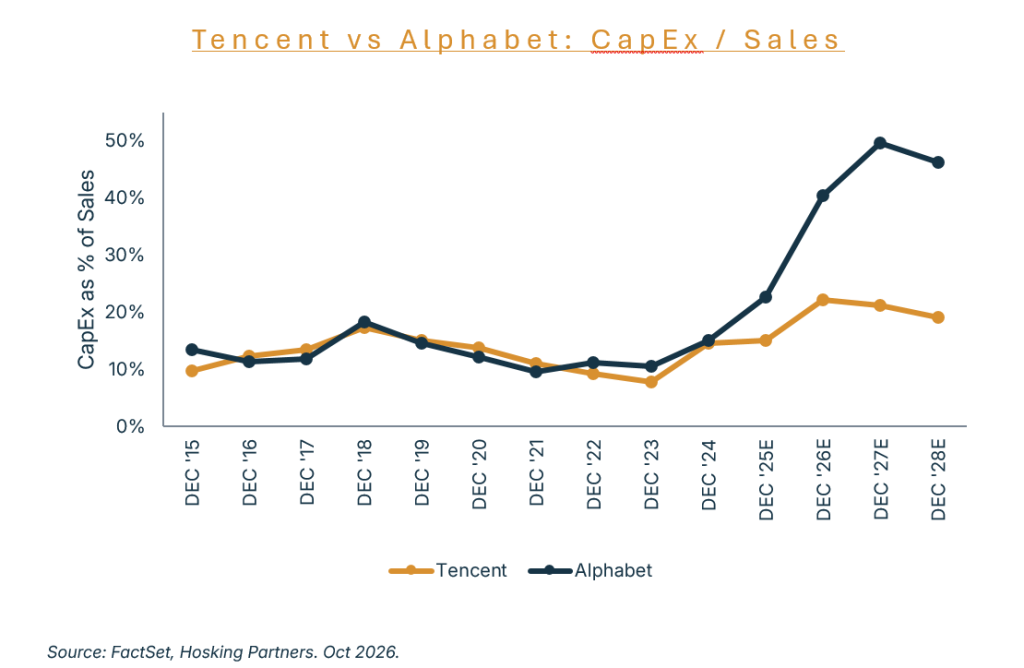
Notwithstanding ostensibly similar starting positions, their responses to recent threats appear wholly different. The numbers suggest that Alphabet, by substantially increasing capex to satisfy the market’s ever-growing desire for AI compute, is dancing to the drumbeat of the rival frontier-model companies who are incentivising the massive investment programmes. As the chart below shows, they are not alone. From an already elevated $90bn in 2025, Alphabet expects to spend around $200bn in capital expenditure in 2026, with another ‘significant increase’ expected in 2027. Capex as a percentage of sales has gone from around 10% to almost 50% in a few short years. Tencent, however, appears to be letting the whole AI revolution pass it by – it spent RMB79bn in 2025 on revenue of RMB752bn, around 10% of sales, roughly where Alphabet sat before this cycle began. While Tencent has plans to increase spend, the proposed amounts are a fraction of those of its US counterparts.
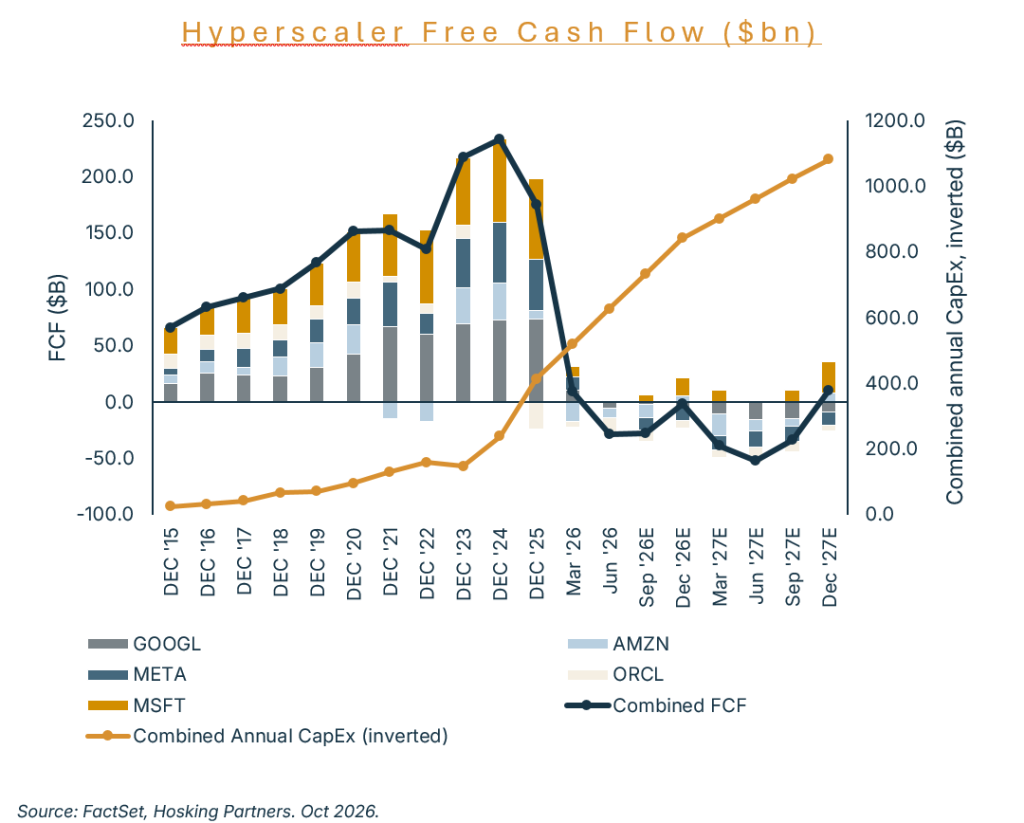
Alphabet is re-arming down the value chain for one main reason: the structural issues within search resulting from large language model (LLM) competition. When an AI answer is made available to Search users, their propensity to click on a link (the heart of the revenue model) halves.[1] As click-through declines, Google has substantially increased both the number and the price of sponsored links to keep monetisation rates high. To date, this has been successful, but the risks to user experience are clear. Capital intensity is increasing at the same time as network effects are being neutered. Search ran on relatively modest, distributed computing power, with network effects constantly improving the algorithm. AI is more brutalist: LLMs demand vast amounts of centralised computation.
The journey looks painful and expensive as Alphabet gets dragged into an AI-compute capital deluge, puppeteered by OpenAI and Anthropic, who continue to dangle unfettered demand growth in front of an increasingly frenetic market. The incentives should give investors across the value chain pause. It is in the frontier models’ interests for there to be as much AI data centre capacity as possible, given supply constraints are both a direct cost and an obstacle to growth.
Until recently, cloud data centre computing in the US was an oligopolistic industry, protected by software and services, which made switching costs high and returns attractive for Amazon, Microsoft and Alphabet. However, as the marginal dollar of data centre capital moves from cloud to AI computing, the aggregate economics change – an inference token, unlike the services offered by a cloud provider, is largely fungible. This allows AI compute customers to be much less discerning, demanding maximum capacity at the lowest possible token cost.
The frontier labs, helped by Nvidia’s extravagant use of its balance sheet, have incentivised the massive capacity build-out by signing multi-year compute contracts far in excess of their current revenues. The hyperscalers use the revenue backlogs to underwrite their capex. Oracle, for example, has increased its capex to sales from 13% in 2023 to 82% last year on the back of a colossal $664bn revenue backlog, almost 10 times current annual revenue. Around half is thought to be tied to OpenAI alone, a company with annualised revenue of $50bn. Our experience in an industry like shipbuilding tells us a backlog is only worth the solvency of the counterparty, and nothing more.
Compare these animal spirits to China, where the value-extraction-mechanism-cum-cheerleader, Nvidia, has been less influential. In October 2025, Nvidia’s CEO said its share of the China market had gone from 95% to zero as export restrictions bit. When the ability to spend capital is limited, inclination follows, and alternatives are sought. Without revenue backlogs to underwrite the build-out, Chinese companies have found ways of creating near-comparable LLMs on remarkably lean capital budgets. This adds to our view that compute is more of a commodity than rhetoric and activity in the US would have us believe.
The stark contrast raises an obvious question: if near-frontier models can be built for a fraction of the cost, what explains Alphabet’s prodigious investment programme? Although unsatisfyingly vague, we suspect it is partly prisoner’s dilemma, partly war of attrition. The former is obvious and was explicitly referenced by the CEO in 2024 – “the risk of underinvesting is dramatically greater than the risk of overinvesting”. Yet Alphabet’s spending plans look reasonably restrained when set against the compute contracts signed by the other frontier labs (well over $1.5trn between OpenAI and Anthropic alone). Whisper it so the DeepMind team does not hear – Alphabet will want to stay close enough to the frontier to matter, but, given the highly uncertain business-model economics, not necessarily to lead it.
This is asymmetric game theory at work. Google Cloud’s own revenue backlog of $514bn deserves the same scepticism we applied to Oracle. But the payoff is quite different. If a frontier lab defaults on Oracle, Oracle loses a customer (and probably its solvency). If a frontier lab defaults on Google, Google loses a competitor. Every dollar the labs pay Google Cloud is a dollar of runway they no longer have. Alphabet is in the enviable position of being able to monetise their competitors burn rate, extracting rent to the point of exhaustion. It is also economically rational – compute goes to whoever pays most, even if that means rivals ahead of Google’s own internal teams.
It is, admittedly, an expensive endeavour. But as well as potentially expediting a reckoning of the frontier LLM business model, Alphabet is building out data centre capacity at what is likely the lowest cost in the industry. By operating at a unit cost-per-token below the threshold forced upon Nvidia-dependent competitors, Google can remain profitable even as inference pricing compresses toward marginal cost. In what looks like a commodity product, position on the cost curve matters.
In China, the technology value chain appears to be evolving into something altogether more familiar. Capital intensity, although picking up, is not overwhelming business models. Treating AI compute and open-weight models as commodities has allowed the incumbent platforms, like Tencent and ByteDance, to maintain their positions in the value chain, as well as find new, profitable revenue streams. When its own model performance was lagging in early 2025, Tencent simply plugged DeepSeek into Weixin – something Alphabet could never do with ChatGPT without substantial value leakage to OpenAI. It has since rebuilt its own model behind that door. All the while, Tencent’s marketing revenue has grown by more than 20% over the past year, and operating margins excluding new AI products have risen to more than 40%. China, it seems, is using AI to make money. In the US it has become something of a religion.[2]
There are some early signs of a loss of faith – Nvidia is looking to foist its GPU residual-value guarantees onto insurance companies; Amazon is exploring selling $8bn worth of GPUs into an SPV and leasing them back; Oracle has invoked force majeure on a 2.5GW data centre project in New Mexico; landlords are requiring more stringent assurances such as Nvidia’s guarantee of up to $105bn of OpenAI’s data centre leases.
In Tencent and Alphabet we believe we are at the secular end of the spectrum. Both appear to be making economically rational decisions, even if strikingly different ones. In our simple world view, capex up, greater competition and pressure on marginal returns point to mediocre returns on incremental capital. High starting valuations make the outlook for shareholder returns more challenging still. Alphabet will undoubtedly suffer as this tried-and-tested sequence takes hold – this is one of the reasons we have been reducing our long-term position in the portfolio. Yet we continue to own it for its counter-positioning against the frontier labs, and its ability to compound its dominance when the cycle turns. We own (and have added to) Tencent for the opposite reason: business-model consistency and the ability to generate substantial value without an extreme change in capital intensity.
Every capital cycle has its zealots, and this one has plenty. The faithful fund the build-out, and the sceptics benefit from the ensuing bust. Despite a seeming abundance of capital available for all things AI, even here capital is no longer free. Poor capital allocation will have consequences, and creative destruction will follow. With such flux and opacity, investment by avoidance seems like a more prudent strategy than investment by prediction. Yet rather than dismiss the sector entirely, as would be the strategy of most contrarian investors, we prefer to look for small pockets of thoughtful behaviour, and then wait patiently for the cycle to do its work.
[1] Pew Research Centre. Without an AI summary users click on traditional links 15% of the time. With an AI summary this drops to 8%. Clicks on links inside the AI summary itself occurred in just 1% of visits.
[2] Read Anthropic’s “Soul Doc” to get into the mind of AI developers.